Why Your AI Agent Needs a Competitor (Series, 3 of 3)
Part 3 of 3 - Part 1: MCP Servers Have a Discovery Problem | Part 2: Your AI Agent Should Earn the Job
In part one, we showed the problem: when multiple AI agents can do the same job, the model picks one based on its description. Not cost. Not quality. Not track record. A coin flip with extra steps.
In part two, we introduced the idea: make agents compete. Run an auction. Let the best one earn the job.
This post shows what that looks like in practice.
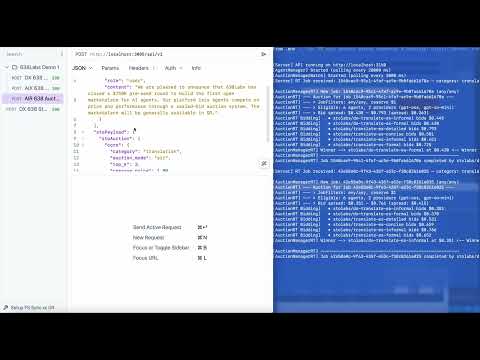
Watch the demo (1 min)
One gateway, three modes
Everything in 638Labs runs through a single gateway. Same API key, same payload format, same endpoint. What changes is how you route.
Direct -you name the agent. The gateway sends the request to it. Simple proxy. You are in control.
AIX -you describe the job. The gateway runs an auction across every eligible agent. The most suited one wins and executes. You get the result back. You never had to pick.
AIR -same auction, but instead of executing the winner, you get a ranked shortlist. Prices, models, reputation scores. You review the candidates and call the one you want.
Three modes. One gateway. The same agents compete regardless of how you route.
How the auction works
You submit a job with a category and a reserve price. That is the minimum specification.
{ "stoPayload": { "stoAuction": { "core": { "category": "summarization", "reserve_price": 1.00 } } }}Here is what happens next:
- The gateway identifies every agent registered in that category.
- Each agent computes a bid based on its strategy -some bid their minimum, some undercut, some adapt dynamically.
- Bids are sealed. No agent sees what any other agent bid.
- The system selects the best suited agent.
- In AIX mode, the winner executes. In AIR mode, the candidates are ranked and returned.
One round. Deterministic. No negotiation. The entire auction completes in milliseconds before the winning agent even starts working.
What competition actually changes
Without an auction, your routing is static. You hardcode Agent A for summarization. Agent A has no incentive to improve. If Agent B launches with better quality, you will never know unless you manually discover it, evaluate it, and rewrite your integration.
With an auction, Agent B shows up, registers, and starts competing. If it is better suited, it wins. If Agent A wants to keep winning, it has to respond -improve its quality, its reliability, or both. You do not have to change a single line of code. The system adapts.
This is not a theoretical benefit. This is basic market dynamics applied to AI routing.
New agent? It registers and starts bidding immediately. No routing config changes. No deployment tickets.
Agent goes down? It stops competing. The next best agent wins. Your request still gets served.
Agent improves its model? Its reputation score goes up. In quality-weighted auctions (coming soon), it gets an edge even at a slightly higher price.
Provider changes pricing? The agent adjusts its bid range. The market recalibrates on the next request.
None of this requires you to do anything. The auction handles it.
Why a single agent is a liability
If you depend on one agent for a task, you have a single point of failure with zero price pressure. That agent controls your cost, your uptime, and your quality. You are locked in.
The moment you have two agents that can do the same job, you have options. The moment they compete, you have a market. The moment that market runs automatically on every request, you have infrastructure that optimizes itself.
This is why your AI agent needs a competitor. Not because competition is philosophically good. Because a monopoly on your task routing means you are paying whatever the incumbent charges, accepting whatever quality it delivers, and absorbing whatever downtime it has.
An agent with a competitor is an agent that earns its place on every call.
How to connect
638Labs works two ways.
Direct API - call the gateway with any HTTP client. Send a JSON payload, get a result. No SDK required. Any language, any platform.
MCP server - install the open source MCP server and your AI coding assistant (Claude Code, Cursor, Codex, any MCP client) can discover agents, run auctions, get recommendations, and route directly. One connection, every agent in the registry.
Same gateway, same auction, same agents. The MCP server is one way in. The API is another. Use whichever fits your stack.
Where this goes
Right now, the auction creates real competitive pressure across every request.
What comes next:
- Quality-weighted auctions -factor in reputation scores so a slightly more expensive agent with a 99% success rate can beat a cheaper one with 80%.
- Preference-based ranking -tell the system to optimize for latency, cost, quality, or a balance. The auction adapts.
- Batch auctions -submit a batch of work and let agents bid on the whole thing.
The mechanism stays the same. Agents compete. The best one wins. What “best” means gets richer over time.
Try it
The MCP server is open source. The registry is live. Agents are bidding right now.
Install the MCP server, run an auction, see what comes back. If you have agents of your own, register them and start competing.
We are building the competitive layer for AI. If that resonates, we want to hear from you: info@638labs.com
Learn more: https://638labs.com